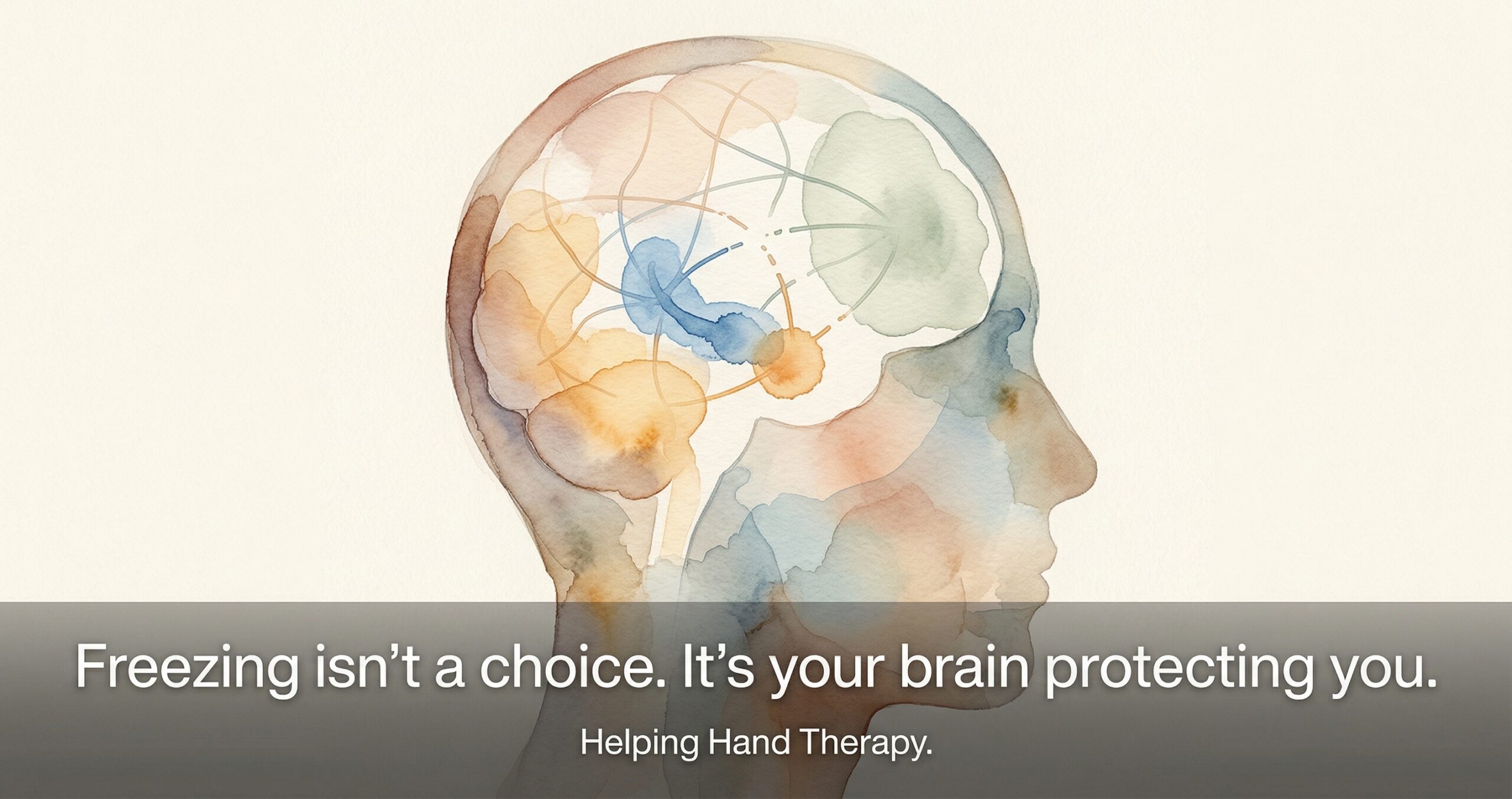
If you’re a survivor who has ever blamed yourself for freezing, for not fighting back, for not remembering clearly, or for “not getting over it” — this article is for you. The neuroscience of sexual trauma explains what happened in your brain during and after the assault. Your response was never a choice. It was protection. And understanding that can be the first step toward self-compassion.
Your Brain Under Threat: What Happens During Sexual Trauma
To understand why survivors respond the way they do, you need to understand what happens in the brain during extreme threat. Three brain regions play critical roles — and all three are profoundly affected by sexual trauma.
The amygdala is the brain’s alarm system. It detects threat — often before conscious awareness — and triggers the body’s survival response. During sexual assault, the amygdala goes into overdrive, flooding the body with stress hormones like cortisol and adrenaline. This is the system that decides, in milliseconds, whether to fight, flee, or freeze.
The hippocampus is responsible for forming coherent, time-stamped memories. Under extreme stress, the hippocampus becomes impaired. Stress hormones disrupt its ability to encode events in sequence, which is why traumatic memories are often fragmented, sensory-heavy, and out of order. This is neurobiology — not unreliability.
The prefrontal cortex — the brain region responsible for reasoning, decision-making, and conscious choice — goes offline during extreme threat. When survival circuits take over, the parts of the brain that allow for deliberate action are suppressed. This is why asking a survivor “Why didn’t you just…?” fundamentally misunderstands what was happening in their brain.
As neuroscientist Dr. Jim Hopper has documented extensively, these neurobiological responses are not unique to any one person. They are the predictable, well-documented effects of extreme stress on the human brain. Every survivor’s brain follows the same basic threat-response architecture — even though each person’s experience is unique.
The Freeze Response: Why “Fighting Back” Isn’t Always Possible
One of the most damaging misconceptions about sexual assault is the belief that a “real” victim would fight back. This misunderstanding causes immeasurable harm — because it leads survivors to blame themselves for a neurological response they had no control over.
Tonic immobility — the clinical term for the freeze response — is an involuntary survival mechanism controlled by the brainstem, not the conscious mind. Research by Möller et al. (2017) in Acta Psychologica found that approximately 70% of sexual assault survivors reported significant tonic immobility during the event — and that tonic immobility was associated with subsequent PTSD and severe depression.
Freezing is not consent. It is not compliance. It is not “letting it happen.” It is the nervous system’s last-resort protective strategy when the brain assesses that fight and flight are not viable options. The body goes still. The mind may dissociate. The vocal cords may stop working. This response evolved to protect the organism from further harm — and it activates automatically, without any conscious decision.
In my practice, helping survivors understand this is often a turning point. The client who has spent years asking themselves “Why didn’t I scream? Why didn’t I run? Why didn’t I fight?” begins to understand: their brain made that decision for them, in milliseconds, to keep them alive. There was no choice involved. Only survival.
Memory Fragmentation: Why Survivors Can’t “Just Tell Us What Happened”
Another common source of self-blame — and external disbelief — is the fragmented nature of traumatic memory. Survivors often can’t provide a clear, chronological account of what happened. They may remember vivid sensory details (a smell, a texture, a sound) while being unable to recall the sequence of events. They may have gaps. They may remember things out of order.
This isn’t a credibility problem. It’s a neuroscience problem.
Research by Bremner (2006) in the Annals of the New York Academy of Sciences documented how traumatic stress impairs hippocampal function, disrupting the brain’s ability to form coherent, time-stamped memories. The amygdala, meanwhile, continues encoding emotional and sensory information at full intensity — which is why a survivor may be triggered by a specific smell or sound years later while being unable to narrate the full event.
Understanding this has profound implications — clinically, legally, and personally. When a survivor’s fragmented memory is treated as evidence of unreliability, the system re-traumatizes them. When it’s understood as a predictable neurological response to extreme stress, it becomes evidence that something genuinely traumatic occurred.
Hypervigilance: When the Threat Never Ends
Long after the assault is over, many survivors experience a state of persistent alertness — a feeling that danger is always nearby, even in objectively safe environments. This is hypervigilance, and it’s driven by the amygdala’s recalibrated threat-detection system.
After trauma, the amygdala essentially lowers its threshold for what constitutes “danger.” Neutral stimuli — a footstep behind you, a certain tone of voice, a particular time of day — can trigger a full survival response. The brain is doing what it was designed to do: protecting you from a threat it believes is still present.
This manifests as exaggerated startle responses, difficulty sleeping, chronic anxiety, difficulty concentrating, and a pervasive sense of unsafety. It’s exhausting. And it’s not something you can simply decide to stop doing — because it’s operating below the level of conscious control.
In clinical work, addressing hypervigilance requires helping the nervous system update its assessment of the current environment. This is where trauma-focused therapies — including somatic approaches that work directly with the body’s threat-response system — can make a meaningful difference. (This connects to work we’ve written about on how the stress response operates and what genuine recovery looks like.)
Healing Is Possible: Neuroplasticity and Recovery
The same neuroplasticity that allows the brain to be changed by trauma also allows it to heal.
Evidence-based trauma therapies — including trauma-focused cognitive behavioral therapy, EMDR (Eye Movement Desensitization and Reprocessing), and somatic experiencing — work by helping the brain process traumatic memories, reduce amygdala hyperactivation, and restore prefrontal cortex function. These aren’t just “talk therapy.” They work directly with the neurological systems that were disrupted by the trauma.
Healing is not linear. There will be difficult days. There will be setbacks. But the trajectory — with the right support — is toward recovery. The brain can form new pathways. The nervous system can recalibrate. The body can learn to feel safe again.
If you’re a survivor reading this, I want you to hear this clearly: nothing about your response during or after the assault was a failure. Your brain did exactly what it was designed to do under extreme threat. Understanding that isn’t just an intellectual exercise — it’s the foundation for self-compassion. And self-compassion is where healing begins.
You don’t have to carry this alone.
Helping Hand Therapy provides trauma-informed, survivor-centered therapy for adults who have experienced sexual trauma — in Medford, Ashland, and throughout Southern Oregon.
Schedule a Free ConsultationIf you are in crisis: National Sexual Assault Hotline — 1-800-656-4673 (RAINN)
Frequently Asked Questions
Why do some survivors freeze during sexual assault?
Freezing — clinically called tonic immobility — occurs when the prefrontal cortex (the brain’s reasoning center) goes offline during extreme threat. This is an involuntary survival response controlled by the brainstem, not a conscious choice. Research by Möller et al. (2017) found that approximately 70% of sexual assault survivors reported significant tonic immobility during the assault. Freezing is not consent, compliance, or weakness — it is the nervous system’s last-resort protective mechanism when fight and flight are not possible.
Why do survivors have gaps in their memory of the assault?
During extreme stress, the hippocampus — the brain region responsible for forming coherent memories — becomes impaired. Stress hormones like cortisol and norepinephrine disrupt normal memory encoding, resulting in fragmented, out-of-sequence, or incomplete memories. This is a well-documented neurological response to trauma, not evidence of unreliability or fabrication. Survivors may remember sensory details vividly while being unable to recall the sequence of events.
What causes hypervigilance after sexual trauma?
The amygdala — the brain’s threat-detection center — becomes hyperactivated after trauma, creating a state of persistent alertness. The brain essentially recalibrates its baseline threat level, interpreting neutral stimuli as potentially dangerous. This manifests as hypervigilance, exaggerated startle responses, difficulty sleeping, and a pervasive feeling of being unsafe even in objectively safe environments. This is an adaptive response — the brain is trying to prevent future harm.
Can the brain heal after sexual trauma?
Yes. Neuroplasticity — the brain’s ability to form new neural pathways and reorganize existing ones — means that trauma-related brain changes are potentially reversible with appropriate support. Evidence-based treatments like trauma-focused cognitive behavioral therapy, EMDR, and somatic experiencing can help the brain process traumatic memories, reduce hyperactivation, and restore regulatory capacity. Healing is not linear, but it is always possible.
Does Helping Hand Therapy offer trauma-informed therapy for sexual assault survivors?
Yes. Helping Hand Therapy provides trauma-informed, survivor-centered therapy for adults who have experienced sexual assault or other forms of sexual trauma. Michael Higginbotham, LPC, serves clients in Medford, Ashland, and throughout Southern Oregon — in-person and via telehealth. Free consultations are available. If you are in crisis, contact the National Sexual Assault Hotline at 1-800-656-4673 (RAINN).
Related reading: It Wasn’t Your Fault: What Every Survivor Needs to Hear | Women’s Mental Health: Beyond “Just Hormones” | Your Stress Makes Sense
About the Author
Michael Higginbotham, LPC is a Licensed Professional Counselor based in Medford, Oregon, and the founder of Helping Hand Therapy. He provides trauma-informed, evidence-based care for adults across the lifespan — specializing in anxiety, depression, trauma, PTSD, and life transitions. He serves clients in Medford, Ashland, and throughout the Rogue Valley — both in-person and via telehealth.