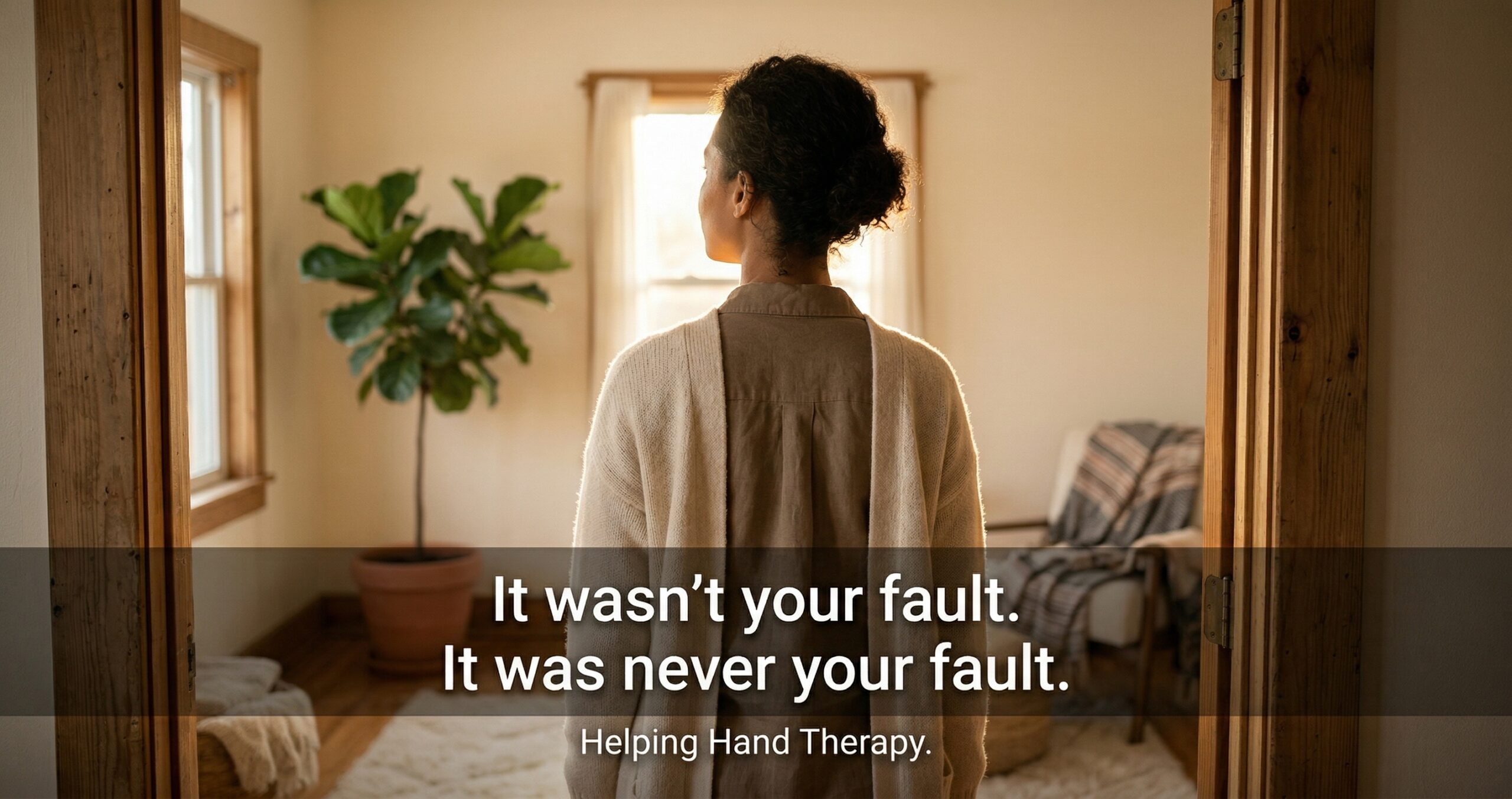
If you are a survivor: It wasn’t your fault. It doesn’t matter what you wore, what you drank, what you said, whether you fought back, whether you knew them, or whether you loved them. The only person responsible for sexual assault is the person who committed it. This article is for you — and for anyone who needs help understanding why self-blame after trauma is common, predictable, and never deserved.
Why Survivors Blame Themselves
Self-blame after sexual assault is one of the most common — and most damaging — psychological responses survivors experience. And it makes a terrible kind of sense.
The human mind craves controllability. If you can identify something you did wrong, you can theoretically prevent it from happening again. “If I hadn’t gone to that party.” “If I hadn’t worn that.” “If I’d said no more clearly.” These thoughts aren’t rational — but they serve a psychological function: they create the illusion that the world is predictable and that you have control.
Research on attributions after sexual assault, including work by Ullman et al. (2007), has consistently found that self-blame is associated with worse psychological outcomes — including higher rates of PTSD, depression, and delayed recovery. Self-blame doesn’t protect survivors. It compounds their suffering.
This pattern is reinforced by a culture that scrutinizes survivors’ behavior rather than perpetrators’ choices. “What were you wearing?” “Why were you there?” “How much did you drink?” Every one of these questions implicitly shifts responsibility from the person who committed the assault to the person who survived it. And over time, survivors internalize the message: Maybe it was my fault.
It wasn’t. It was never your fault.
Your Body’s Response Was Not a Choice
One of the deepest sources of self-blame comes from the body itself. Survivors often carry shame about how they responded during the assault: “I froze.” “I didn’t scream.” “I didn’t fight.” “I just let it happen.”
None of those were choices.
As we explore in detail in our companion article on the neurobiology of sexual trauma, the brain’s response during extreme threat is involuntary. The prefrontal cortex — the part of the brain responsible for conscious decision-making — goes offline. The brainstem takes over, activating whichever survival strategy it calculates has the best chance of keeping you alive.
For approximately 70% of sexual assault survivors, that strategy is tonic immobility — freezing. For others, it’s fawning (complying to reduce harm), dissociating (mentally leaving the body), or going numb. None of these are consent. None are compliance. They are the nervous system’s last-resort protective mechanisms.
Your body did what it needed to do to get you through. And you’re still here. That’s not a failure. That’s survival.
What You Need to Hear
If you’re a survivor reading this, I want to say directly what you may not have heard — or what you may need to hear again:
It wasn’t your fault. Not what you wore. Not what you drank. Not where you were. Not what you said or didn’t say. Not whether you fought back. Not whether you knew the person. Not whether you loved them.
Your body’s responses were not consent. Freezing was not “letting it happen.” Fawning was not agreement. Dissociating was not indifference. Going silent was not permission. These were survival strategies — your brain protecting you in the only way it could.
You didn’t deserve it. Not then. Not ever. No behavior, no clothing, no circumstance, no history justifies sexual violence. The responsibility belongs entirely to the person who committed the assault.
You don’t deserve the weight of it now. The shame you carry, the questions you replay, the blame you’ve internalized — none of that belongs to you. It was placed on you by a culture that asks the wrong questions and a brain trying desperately to make sense of something senseless.
You are believed. Here, right now, without qualification: you are believed.
The Path Forward: From Self-Blame to Self-Compassion
Moving from self-blame to self-compassion is rarely a single moment. It’s a process — sometimes slow, sometimes nonlinear, always worthy of patience.
In my clinical work with survivors, this process often begins with understanding the neuroscience. When a client learns that their freeze response was involuntary — that their brain was literally protecting them — something shifts. The narrative changes from “I failed” to “My brain saved me.” That reframe doesn’t erase the pain. But it redirects the blame away from the self and toward the truth: the only person responsible is the person who caused the harm.
It continues with naming the cultural narratives that fuel self-blame. We don’t blame ourselves in a vacuum. We do it because we’ve been taught to — by a society that asks survivors what they could have done differently instead of asking perpetrators why they made the choice they did. Therapy can help you identify those internalized narratives and begin to challenge them.
And it deepens through community. Connecting with other survivors — whether in support groups, online communities, or simply through the knowledge that you are not alone — can be profoundly healing. Self-blame thrives in isolation. It weakens in connection.
If you’re not ready for therapy, that’s okay. If you’re not ready to talk about it at all, that’s okay too. Your timeline is yours. But I want you to know: when you are ready, there are people who will believe you, who will not judge you, and who will walk alongside you for as long as the journey takes.
You don’t have to carry this alone.
Helping Hand Therapy provides trauma-informed, survivor-centered therapy — in Medford, Ashland, and throughout Southern Oregon. In-person and via telehealth.
Schedule a Free ConsultationIf you are in crisis: National Sexual Assault Hotline — 1-800-656-4673 (RAINN)
Frequently Asked Questions
Why do survivors blame themselves after sexual assault?
Self-blame after sexual assault is extremely common and is driven by several factors: the human need to believe the world is controllable and just, societal narratives that scrutinize survivors’ behavior rather than perpetrators’ choices, and the psychological impact of betrayal by someone trusted. Self-blame is also reinforced when survivors’ neurological responses during trauma — like freezing or not fighting back — are misunderstood as choices. Self-blame is a predictable psychological response, not evidence that the survivor did anything wrong.
I didn’t fight back — does that mean it was my fault?
Absolutely not. Research shows that approximately 70% of sexual assault survivors experience tonic immobility — an involuntary freeze response controlled by the brainstem, not by conscious choice (Möller et al., 2017). Your brain made a split-second survival decision to protect you. Freezing, fawning, going numb, or dissociating are all neurological protective responses. None of them are consent. None of them are complicity. The only person responsible for assault is the person who committed it.
How do I stop blaming myself?
Self-blame often feels deeply true even when it isn’t. Working with a trauma-informed therapist can help you understand the neuroscience behind your trauma response, challenge the internalized narratives that fuel self-blame, and build genuine self-compassion. Understanding that your brain’s response was protective — not a failure — is often a turning point. Healing from self-blame takes time, and it’s okay to need support with it.
What should I do if I’m a survivor and need help?
You deserve support, and you don’t have to navigate this alone. The National Sexual Assault Hotline (RAINN) is available 24/7 at 1-800-656-4673 — free and confidential. You can also reach out to a trauma-informed therapist in your area. Helping Hand Therapy provides survivor-centered therapy in Medford, Ashland, and throughout Southern Oregon — in-person and via telehealth. Free consultations are available.
Related reading: The Neurobiology of Sexual Trauma: Why Survivors Respond the Way They Do | Women’s Mental Health: Beyond “Just Hormones” | Neurodiversity-Affirming Therapy
About the Author
Michael Higginbotham, LPC is a Licensed Professional Counselor based in Medford, Oregon, and the founder of Helping Hand Therapy. He provides trauma-informed, evidence-based care for adults across the lifespan — specializing in anxiety, depression, trauma, PTSD, and life transitions. He serves clients in Medford, Ashland, and throughout the Rogue Valley — both in-person and via telehealth.