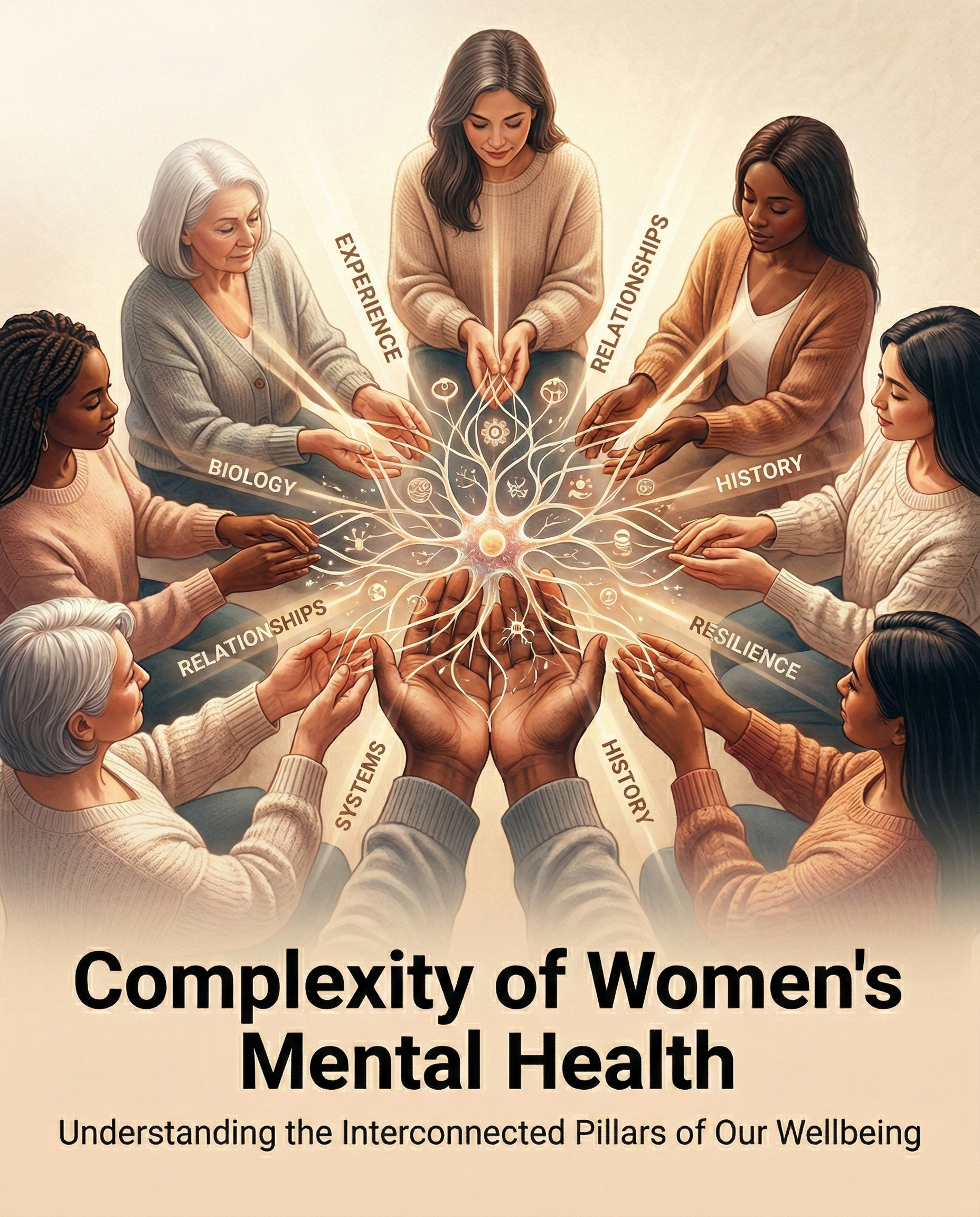
“It’s probably just hormones.” Four words that have derailed more women’s mental healthcare than any diagnostic manual ever could. If you’ve ever been told your distress was “just PMS,” that you were “being too emotional,” or that your symptoms were “normal for a woman your age” — this post is for you. What you experienced wasn’t care. It was dismissal. And the science says you deserve better.
Women’s Mental Health by the Numbers — And What the Data Misses
Women in the United States experience depression at nearly twice the rate of men — a pattern documented across decades of epidemiological research. According to the National Institute of Mental Health, depression, anxiety disorders, and eating disorders are all more common in women than men. Women also show higher rates of any mental illness (26.4%) compared to men (19.7%), according to NIMH prevalence data.
But here’s where the conversation usually goes wrong: those statistics get reduced to a single explanation — hormones.
Yes, hormonal fluctuations are real. Conditions like premenstrual dysphoric disorder (PMDD), which affects approximately 3–8% of women of reproductive age, and postpartum depression, which affects roughly 1 in 8 women in the United States, are serious and deserve clinical attention. But framing the entirety of women’s mental health as a hormone problem is both scientifically incomplete and clinically harmful.
As a therapist, I’ve sat across from countless women who arrived in my office not because they were “too hormonal” — but because they’d been carrying the weight of impossible expectations, systemic barriers, and years of being told their pain wasn’t real. Hormones may be one thread in the fabric. They are never the whole cloth.
Medical Dismissal and Women’s Mental Health: When the System Fails
There is a growing body of research documenting what many women already know from lived experience: the healthcare system frequently dismisses, minimizes, or misattributes women’s symptoms.
A 2025 study published in JAMA Network Open examined gaslighting experiences among patients with vulvovaginal disorders and found that 39.4% of patients reported clinicians made them “feel crazy” — rating it as the most distressing clinical behavior they experienced (Moss et al., 2025). Over half (52.8%) considered ceasing care entirely because their concerns were not addressed.
A qualitative study in Frontiers in Public Health explored cis women’s experiences navigating healthcare systems alongside mental illness diagnoses, finding patterns of diagnostic overshadowing, emotional suppression to avoid dismissal, and significant self-advocacy labor just to receive basic care (Zirnsak et al., 2024).
This isn’t just bad bedside manner. It’s a systemic pattern with measurable harm. When women learn that reporting symptoms leads to dismissal, they stop reporting. When they stop reporting, conditions worsen. The dismissal itself becomes a health risk.
In my practice, I’ve watched this play out over and over. A woman arrives in therapy after years of being told her anxiety is “just stress” or her depression is “just hormones.” By the time she reaches my office, she’s internalized the message: Maybe I am just too much. Undoing that message is often where the real therapeutic work begins.
Beyond Hormones: The Social and Systemic Factors Shaping Women’s Mental Health
The biopsychosocial model — the framework most mental health professionals rely on — tells us that mental health is shaped by the interaction of biological, psychological, and social factors. For women, all three domains carry unique burdens.
Biological Factors
Biological factors are real but partial. Reproductive hormonal shifts can influence mood — but so can sleep deprivation from caregiving, the chronic stress of workplace discrimination, and the physiological toll of experiencing or fearing gender-based violence. Biology doesn’t happen in a vacuum.
Psychological Factors
Psychological factors include gender socialization patterns that begin in childhood. Research by Chaplin (2015) demonstrates that girls are socialized toward greater expression of internalizing emotions like sadness and anxiety, while suppressing outward anger — a pattern that tracks directly onto higher rates of depression and anxiety disorders in adulthood. Importantly, Chaplin notes this research was conducted primarily with White, middle-class U.S. samples, so universal generalizations should be made with caution.
Social and Systemic Factors
Social and systemic factors compound these vulnerabilities. An estimated 66% of all caregivers are female, and female caregivers may spend up to 50% more time providing care than male caregivers, according to the Family Caregiver Alliance. Middle-aged and older women caring for an ill or disabled spouse are almost six times more likely to experience depressive and anxious symptoms than non-caregivers.
Women also remain underrepresented in clinical trials relative to their disease burden — in psychiatry, women represent 60% of people with psychiatric disorders yet comprised only 42% of clinical trial participants in a large-scale review of trials from 2016–2019 (Sosinsky et al., 2022).
The system was not built with women’s health at the center. The NIH didn’t mandate the inclusion of women in federally funded clinical research until the Revitalization Act of 1993. For decades before that, the “default” research subject was male. The consequences of that gap are still being felt.
Intersectionality and Women’s Mental Health: Race, Identity, and Unequal Burdens
Any honest conversation about women’s mental health must account for the fact that “women” is not a monolith. The concept of intersectionality — developed by legal scholar Kimberlé Crenshaw (1989) beginning with her foundational analysis of how race and gender discrimination overlap for Black women, and substantially expanded in her 1991 work — is essential here.
The data bears this out. Research consistently shows that postpartum depression rates vary significantly by race and ethnicity: American Indian/Alaska Native and Black mothers experience postpartum depressive symptoms at substantially higher rates than White mothers — differences that reflect systemic inequities in healthcare access, exposure to discrimination, and chronic stress, not biological variation (Bauman et al., 2020, MMWR).
Research by Woods-Giscombé (2010) identified what she termed the “Superwoman Schema” among African American women — a set of culturally rooted expectations including an obligation to manifest strength, suppress emotions, and resist vulnerability. While these traits can be sources of resilience, the research found they are also linked to suppressed emotional processing and barriers to seeking mental health support.
A qualitative study examining race- and gender-related stress among Black women found that participants identified unique stressors — including safety of their children, being the head of the family, and navigating racism in daily life — that compound with the general stressors all women face (Tipre & Carson, 2022).
As a therapist, I hold this awareness as foundational: the mental health challenges my clients face are never just individual. They are always situated within systems — systems of care, systems of power, systems that were built without certain people in mind.
What Real Women’s Mental Health Support Actually Looks Like
So what does it look like to move beyond “just hormones”?
It starts with validation. When a woman tells you she’s struggling, believe her. Don’t look for the hormonal explanation first. Don’t reach for the dismissal. Her distress is real, and it exists within a context that likely includes very real stressors that have nothing to do with her menstrual cycle.
It continues with systemic awareness. Clinicians, partners, employers, and communities all play a role. Designing workplaces that don’t burn out women and femmes. Healthcare systems that listen before they label. Research paradigms that include women as more than an afterthought.
And it includes self-compassion. If you’ve spent years wondering whether you’re “too emotional” or “just hormonal” — consider the possibility that you were never the problem. You were responding to a world that asked too much and offered too little support.
In my work with women across the lifespan — from young adults navigating identity formation, to mothers carrying invisible labor, to women in midlife reckoning with what they’ve been carrying — I see the same core need: to be seen as whole. Not as a collection of symptoms. Not as a hormonal imbalance. But as a full person whose mental health is shaped by biology, experience, relationships, systems, and history — all at once.
Looking for a therapist who approaches women’s mental health with the complexity it deserves?
Helping Hand Therapy offers in-person and telehealth counseling for women across the lifespan — serving Medford, Ashland, and the Rogue Valley.
Frequently Asked Questions About Women’s Mental Health
Why do women experience depression at higher rates than men?
Women experience depression at nearly twice the rate of men due to a combination of biological, psychological, and social factors. These include hormonal variations across the reproductive lifespan, gender socialization patterns that encourage emotional suppression, higher rates of caregiving burden, exposure to gender-based violence, and systemic barriers in healthcare access. Attributing this disparity to hormones alone is both scientifically incomplete and clinically harmful.
What is medical gaslighting and how does it affect women?
Medical gaslighting occurs when a healthcare provider dismisses, minimizes, or misattributes a patient’s symptoms without appropriate evaluation. Research published in JAMA Network Open (Moss et al., 2025) found that nearly 40% of women with vulvovaginal disorders were made to feel “crazy” by providers, and more than half considered stopping care altogether. Gaslighting is a systemic pattern — not just a communication problem — and its health consequences are measurable.
What is the biopsychosocial model of women’s mental health?
The biopsychosocial model understands mental health as the product of three interacting systems: biological factors (such as reproductive hormones and neurological function), psychological factors (such as socialization, self-concept, and coping patterns), and social factors (such as caregiving burden, discrimination, workplace stress, and economic inequity). For women, all three domains carry unique pressures that a purely biomedical or hormonal framework fails to capture.
How does race affect women’s mental health outcomes?
Race shapes women’s mental health through systemic inequities, not biology. Research consistently shows that American Indian/Alaska Native and Black mothers experience postpartum depression at substantially higher rates than White mothers — differences driven by barriers to healthcare access, exposure to racism and discrimination, and the cumulative stress of navigating systems not designed with their needs in mind (Bauman et al., 2020).
What is postpartum depression and how common is it?
Postpartum depression (PPD) is a serious mood disorder that can develop during pregnancy or after childbirth. Symptoms include persistent sadness, loss of interest, fatigue, difficulty bonding with the baby, and anxiety. In the United States, approximately 1 in 8 women experiences postpartum depression (CDC). It is treatable with therapy, medication, or a combination of both — and early support significantly improves outcomes.
How do I know if I need therapy for women’s mental health concerns?
Consider speaking with a licensed therapist if you experience persistent sadness, anxiety, or overwhelm that affects your daily functioning; if you’ve been told your symptoms are “just hormones” but feel that something more is going on; if you’re navigating a major life transition, pregnancy or postpartum period, caregiving role, or identity-related stress; or if you simply want a supportive space to process your experience with someone who takes your concerns seriously. Helping Hand Therapy serves women in Medford, Ashland, and throughout Southern Oregon — in-person and via telehealth.
About the Author
Michael Higginbotham, LPC is a Licensed Professional Counselor based in Medford, Oregon, and the founder of Helping Hand Therapy. He specializes in working with adults across the lifespan on anxiety, depression, identity, life transitions, and women’s mental health. As a trained researcher and licensed clinician, Michael is committed to evidence-based, trauma-informed care that honors the full complexity of each person’s experience. He serves clients in Medford, Ashland, and throughout the Rogue Valley — both in-person and via telehealth.
Clinical References
Bauman, B. L., Ko, J. Y., Cox, S., D’Angelo, D. V., Warner, L., Folger, S., Tevendale, H. D., Coy, K. C., Harrison, L., & Barfield, W. D. (2020). Vital signs: Postpartum depressive symptoms and provider discussions about perinatal depression — United States, 2018. MMWR Morbidity and Mortality Weekly Report, 69(19), 575–581. CDC
Centers for Disease Control and Prevention. (2023). Depression among women. CDC
Chaplin, T. M. (2015). Gender and emotion expression: A developmental contextual perspective. Emotion Review, 7(1), 14–21. PMC
Crenshaw, K. (1989). Demarginalizing the intersection of race and sex: A Black feminist critique of antidiscrimination doctrine, feminist theory and antiracist politics. University of Chicago Legal Forum, 1989(1), 139–167. Source
Family Caregiver Alliance. (n.d.). Women and caregiving: Facts and figures. Source
Kessler, R. C., Berglund, P., Demler, O., Jin, R., Koretz, D., Merikangas, K. R., Rush, A. J., Walters, E. E., & Wang, P. S. (2003). The epidemiology of major depressive disorder: Results from the National Comorbidity Survey Replication (NCS-R). JAMA, 289(23), 3095–3105. PubMed
MGH Center for Women’s Mental Health. (n.d.). PMS and PMDD. Source
Moss, C. F., Chinna-Meyyappan, A., Skovronsky, G., Holloway, J., Lorenzini, S., Muhammad, N., Kopits, I., Perelmuter, S., Mitchell, L., Rief, M., Krapf, J., Pukall, C., & Goldstein, A. (2025). Experiences of care and gaslighting in patients with vulvovaginal disorders. JAMA Network Open, 8(5), e259486. DOI
National Institute of Mental Health. (n.d.). Mental illness statistics. NIMH
National Institute of Mental Health. (n.d.). Women and mental health. NIMH
National Institutes of Health, Office of Research on Women’s Health. (n.d.). History of women’s participation in clinical research. NIH
Sosinsky, A. Z., Rich-Edwards, J. W., Engmann, A., & Grodstein, F. (2022). Enrollment of female participants in United States drug and device phase 1–3 clinical trials between 2016 and 2019. Contemporary Clinical Trials, 115, 106718. DOI
Tipre, M., & Carson, T. L. (2022). A qualitative assessment of gender- and race-related stress among Black women. Women’s Health Reports, 3(1), 224–231. PMC
Woods-Giscombé, C. L. (2010). Superwoman schema: African American women’s views on stress, strength, and health. Qualitative Health Research, 20(5), 668–683. PMC
Zirnsak, T., Elwyn, R., McLoughlan, G., Le Couteur, E., Green, C., Hill, N., Roberts, R., & Maylea, C. (2024). “I have to fight for them to investigate things”: A qualitative exploration of physical and mental healthcare for women diagnosed with mental illness. Frontiers in Public Health, 12, 1360561. DOI