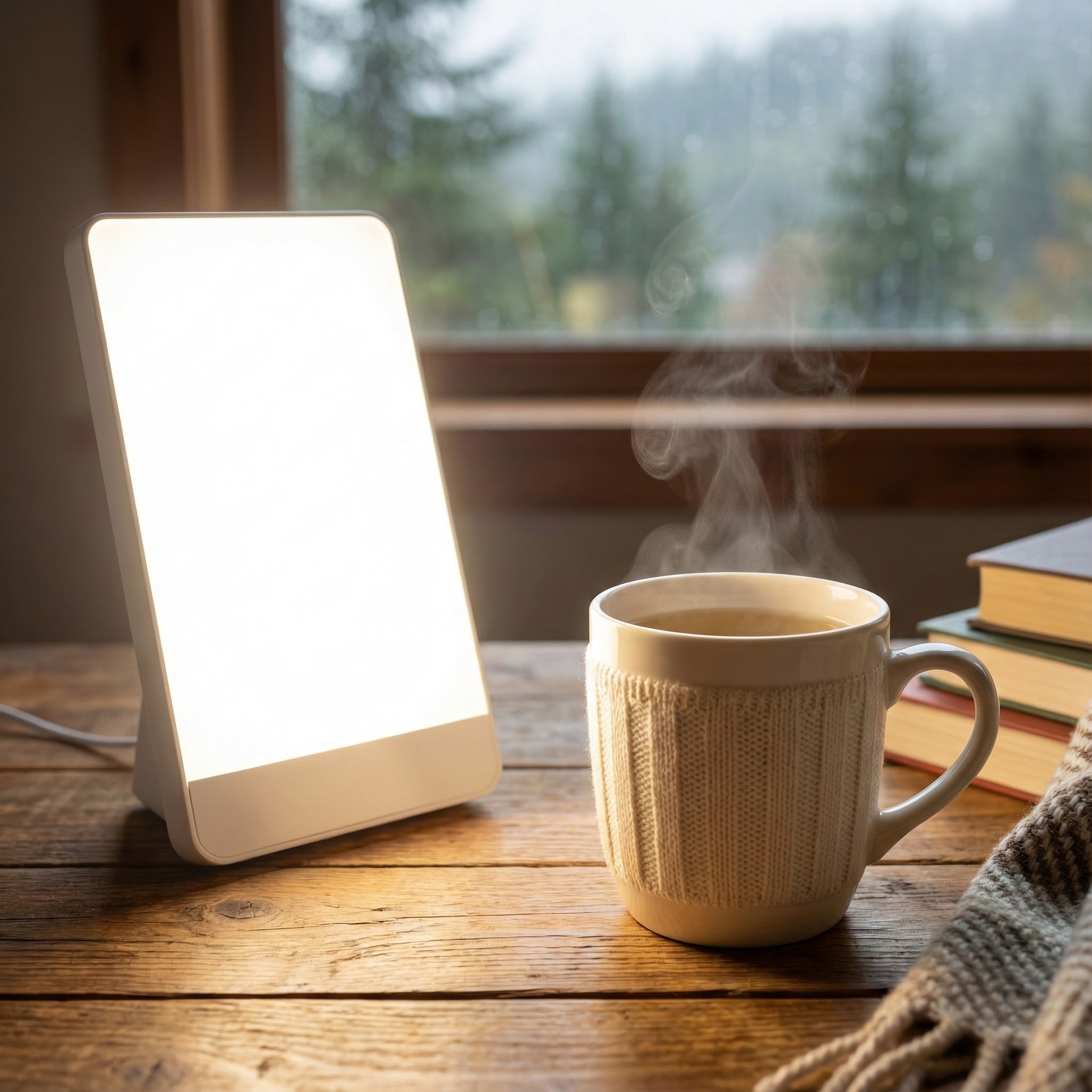
If you live in Southern Oregon, you know the drill. Somewhere around late October, the vibrant autumn colors fade, the rain sets in, and a gray blanket seems to cover the Rogue Valley until April.
For many of us, this shift brings a natural desire to slow down. We might want to stay in our pajamas a little longer or trade a night out for a book by the fire. This is often called the “winter blues,” and it’s a normal response to the changing seasons.
But for about 5% of adults, the arrival of winter brings something much heavier. It’s not just a desire to rest; it’s an inability to function. It’s a fog that won’t lift.
As a Licensed Professional Counselor, I hear this story often in January: “I feel like a completely different person than I was in July. I’m tired all the time, I’m irritable, and I just want to hibernate.”
If this sounds like you, you might be dealing with Seasonal Affective Disorder (SAD). The good news? It is real, it is biological, and it is highly treatable.
What Is Seasonal Affective Disorder?
Seasonal Affective Disorder (SAD) isn’t just an attitude problem or “being lazy.” In the clinical world, it is classified as Major Depressive Disorder with a seasonal pattern. This means it carries the same weight and symptoms as clinical depression, but it arrives and departs like clockwork with the seasons.
While the “winter blues” might leave you feeling a bit “blah,” SAD interferes with your daily life. It affects your work, your relationships, and your sense of self-worth.
Research from the National Institute of Mental Health (NIMH) shows that SAD is four times more common in women than men and occurs more frequently in northern regions. Here in the Pacific Northwest, where our winter days are short and often overcast, our risk is significantly higher than someone living in Florida.
Signs and Symptoms: The “Hibernation” Mode
One of the key differences between SAD and typical depression is how it shows up in your body. Typical depression often causes insomnia and loss of appetite. SAD, however, tends to look like hibernation.
Common signs include:
- Oversleeping (Hypersomnia): You sleep 9, 10, or 12 hours but still wake up exhausted.
- “Leaden Paralysis”: Your arms and legs feel physically heavy, as if you’re walking through mud.
- Carbohydrate Cravings: You feel an intense need for bread, pasta, and sugar (your brain’s attempt to get a quick energy spike).
- Social Withdrawal: You stop answering texts and avoid friends, not just because you’re cozy, but because socializing feels impossible.
- Mood Changes: Feeling hopeless, worthless, or irritable.
The Science: When Your Internal Clock Breaks
Why does this happen? It comes down to a mismatch between your internal clock and the external world.
Think of your brain like a solar-powered battery. It relies on sunlight to regulate two key chemicals:
- Melatonin: The hormone that makes you sleepy. Darkness triggers melatonin. In our dark Oregon winters, your brain may produce melatonin all day long, leaving you in a permanent state of grogginess.
- Serotonin: The neurotransmitter that boosts mood. Sunlight helps trigger serotonin production. Less sun means less serotonin.
When you combine high melatonin (sleepy) with low serotonin (sad), you get the perfect biological recipe for SAD. It’s not a weakness of character; it’s a circadian rhythm disruption.
5 Evidence-Based Tools to “Reset” Your Brain
Because SAD is biological, we can use biological and behavioral tools to treat it. Here are five interventions supported by peer-reviewed research that you can try at home.
1. Bright Light Therapy (The Gold Standard)
This is the most researched and effective treatment for SAD. A study published in the American Journal of Psychiatry found that light therapy is as effective as medication for many people. It works by hitting the retina with intense light, tricking your brain into thinking it’s spring.
How to do it:
- Get the right lamp: You need a specific “light therapy box” that emits 10,000 lux (standard lamps are not bright enough).
- Timing is key: Use it within the first hour of waking up.
- Duration: Sit in front of it (about 16-24 inches away) for 20–30 minutes. You can eat breakfast or read, just don’t look directly into the bulb.
Best used when: You struggle to wake up or feel groggy in the mornings. (Note: If you have bipolar disorder or eye conditions, consult your doctor first, as bright light can trigger mania or eye strain.)
2. “Opposite Action” (Behavioral Activation)
When you have SAD, your brain screams, “Stay in bed! Don’t go out!” Behavioral Activation—a core component of Cognitive Behavioral Therapy (CBT)—teaches us that action precedes motivation. We don’t wait until we feel like doing it; we do it, and the feeling follows.
How to practice:
- Identify the urge (e.g., “I want to cancel lunch with my friend”).
- Acknowledge that this urge is a symptom of SAD, not “what you really want.”
- Do the opposite of the urge. Go to the lunch. Even if you only stay for 30 minutes.
Best used when: You feel the urge to isolate or withdraw socially.
3. Morning Movement Outdoors
Research shows that combining light exposure with physical movement is a “double whammy” for depression. Even on a cloudy day, the light outside is significantly brighter than your office lighting.
How to practice: Commit to a 10-minute walk outside before noon. It doesn’t have to be a workout. Just putting your shoes on and walking around the block signals to your brain that the day has started.
Best used when: You feel “leaden paralysis” or low energy.
4. Vitamin D Supplementation
Approximately 70% of Americans have insufficient Vitamin D levels in the winter. Since Vitamin D is crucial for mood regulation, a deficiency can mimic or worsen depression.
How to practice:
- Ask your doctor for a simple blood test to check your levels.
- If you are deficient, follow their recommendation for supplementation.
- Focus on Vitamin D-rich foods like salmon, fortified dairy/plant milks, and eggs.
Best used when: You want to support your brain’s baseline health holistically.
5. Prioritize “Complex” Comfort Foods
Your brain craves sugar because it wants a quick serotonin spike. But sugar leads to a crash, worsening your mood. Instead, fuel your brain with complex carbohydrates and proteins that provide steady energy.
How to practice: Instead of a donut (quick spike/crash), try oatmeal with walnuts (complex carb + omega-3s). You still get the warm comfort food, but without the mood crash.
When to Seek Professional Help
Best used when: You find yourself standing in the pantry craving sweets.
While these tools are powerful, they aren’t always enough. If you find that your symptoms are preventing you from going to work, caring for your family, or enjoying life at all, it’s time to call in reinforcements.
Seeking therapy isn’t a sign of defeat. It’s a strategy. Therapies like Cognitive Behavioral Therapy (CBT) are proven to help rewire the negative thought patterns that accompany SAD.
Trusted Resources
- National Institute of Mental Health – Seasonal Affective Disorder Comprehensive, science-based overview of symptoms, causes, and treatments.
- Center for Environmental Therapeutics A non-profit providing educational materials and self-assessment tools for circadian rhythm disorders and light therapy selection.
- Mayo Clinic – SAD Overview Reliable medical information on diagnosis and treatment options.
Conclusion
Winter in Southern Oregon is beautiful, but it can also be hard. If you are struggling, please know that you are not broken. You are simply a human being with a biological system that needs light.
Be gentle with yourself. Try one of these tools tomorrow morning. And remember: the days are already getting longer. Spring is coming.
How We Can Help
If you’re in Southern Oregon and looking for support with winter depression or anxiety, I’d be honored to help. At Helping Hand Therapy, we provide compassionate, evidence-based care in Ashland and Medford, as well as online throughout Oregon. Schedule a free 30-minute consultation at helpinghandtherapy.net to see if we’re a good fit.
You can also visit our website at helpinghandtherapy.net for our community calendar, additional resources, and helpful tools.
If you’re in crisis:
- 988 Suicide & Crisis Lifeline: Call or text 988 (available 24/7)
- Crisis Text Line: Text HOME to 741741
- SAMHSA National Helpline: 1-800-662-4357
REFERENCES (APA Format)
American Psychiatric Association. (2013). Diagnostic and statistical manual of mental disorders (5th ed.). American Psychiatric Publishing.
Golden, R. N., Gaynes, B. N., Ekstrom, R. D., Hamer, R. M., Jacobsen, F. M., Suppes, T., … & Nemeroff, C. B. (2005). The efficacy of light therapy in the treatment of mood disorders: a review and meta-analysis of the evidence. American Journal of Psychiatry, 162(4), 656-662.
National Institute of Mental Health. (2023). Seasonal Affective Disorder. Retrieved from https://www.nimh.nih.gov/health/publications/seasonal-affective-disorder
Penckofer, S., Kouba, J., Byrn, M., & Estwing Ferrans, C. (2010). Vitamin D and depression: where is all the sunshine?. Issues in Mental Health Nursing, 31(6), 385-393.
Rohan, K. J., Mahon, J. N., Evans, M., Ho, S. Y., Meyerhoff, J., Postolache, T. T., & Vacek, P. M. (2015). Randomized trial of cognitive-behavioral therapy vs. light therapy for seasonal affective disorder: acute outcomes. American Journal of Psychiatry, 172(9), 862-869.