Have you ever wondered why you panic when a partner doesn’t text back immediately? Or perhaps why you feel the urge to run away the moment a relationship starts to feel “too close”?
You aren’t “crazy,” and you aren’t broken. You are simply following a map that was drawn a long time ago.
As a Licensed Professional Counselor here in Southern Oregon, I see high-functioning, compassionate people every day who feel baffled by their own relationship behaviors. They want connection, yet they find themselves stuck in the same painful loops of chasing or distancing.
Here is the hopeful thesis of today’s post: Your history explains your patterns, but it does not have to dictate your future. Let’s explore the science of attachment and how you can actually rewire your brain for secure, lasting connection.
What Is Attachment Theory?
Attachment theory, originally developed by British psychologist John Bowlby, is the study of how we bond with others. It suggests that our earliest relationships with caregivers—usually in the first 18 months of life—create a “blueprint” for how we expect love to work.
If your caregivers were consistent and responsive, you likely developed a “Secure” blueprint. You learned: If I am in distress, someone will come. I am safe.
However, if care was inconsistent, frightening, or emotionally distant, your brain had to adapt. It developed specific survival strategies to ensure you stayed as safe as possible. These strategies become your Attachment Style.
According to research in the Journal of Personality, these styles affect everything from how we handle conflict to how we manage stress at work. But here is the critical part: they are not labels to judge yourself by. They are simply your nervous system’s way of trying to protect you.
The 4 Attachment Styles: Which One Are You?
While human beings are complex, researchers generally categorize adult attachment into four main styles. Do you recognize yourself in any of these?
1. Secure Attachment (Approx. 50-60% of people)
- The Experience: You generally feel comfortable with intimacy and independence. You don’t panic when a partner is away, but you also don’t fear relying on them.
- The Mantra: “I am okay, and you are okay.”
2. Anxious-Preoccupied Attachment (Approx. 20%)
- The Experience: You often feel nervous about your relationships. You might need frequent reassurance to feel safe and may be labeled as “clingy” or “sensitive.” You are highly attuned to shifts in your partner’s mood.
- The Mantra: “I am not okay, but you are okay (and I need you to complete me).”
3. Dismissive-Avoidant Attachment (Approx. 25%)
- The Experience: You value independence above all else. Emotional intimacy can feel suffocating or dangerous. When things get serious, your instinct is to pull away or shut down.
- The Mantra: “I am okay, you are not okay (I don’t need anyone).”
4. Fearful-Avoidant (Disorganized) Attachment (Approx. 5%)
- The Experience: This is often rooted in trauma. You crave closeness but are terrified of it. You might feel caught in a “come here/go away” cycle, feeling unsafe when alone but also unsafe when close.
- The Mantra: “I am not safe, and you are not safe.”
The Science Behind It: Your Brain on Attachment
This isn’t just “in your head”—it’s in your biology.
Think of your amygdala (the brain’s threat detection center) like a smoke alarm.
- For Securely attached people, the alarm is calibrated correctly. It goes off only when there is a real fire.
- For Anxiously attached people, the alarm is hypersensitive. A missed call or a change in tone triggers a full “fight or flight” panic response.
- For Avoidantly attached people, the brain often suppresses the alarm to avoid the pain of rejection. Research published in PLOS ONE shows that while avoidant individuals may look calm on the outside, their physiological stress levels are often just as high as anxious individuals—they’ve just learned to disconnect from the feeling.
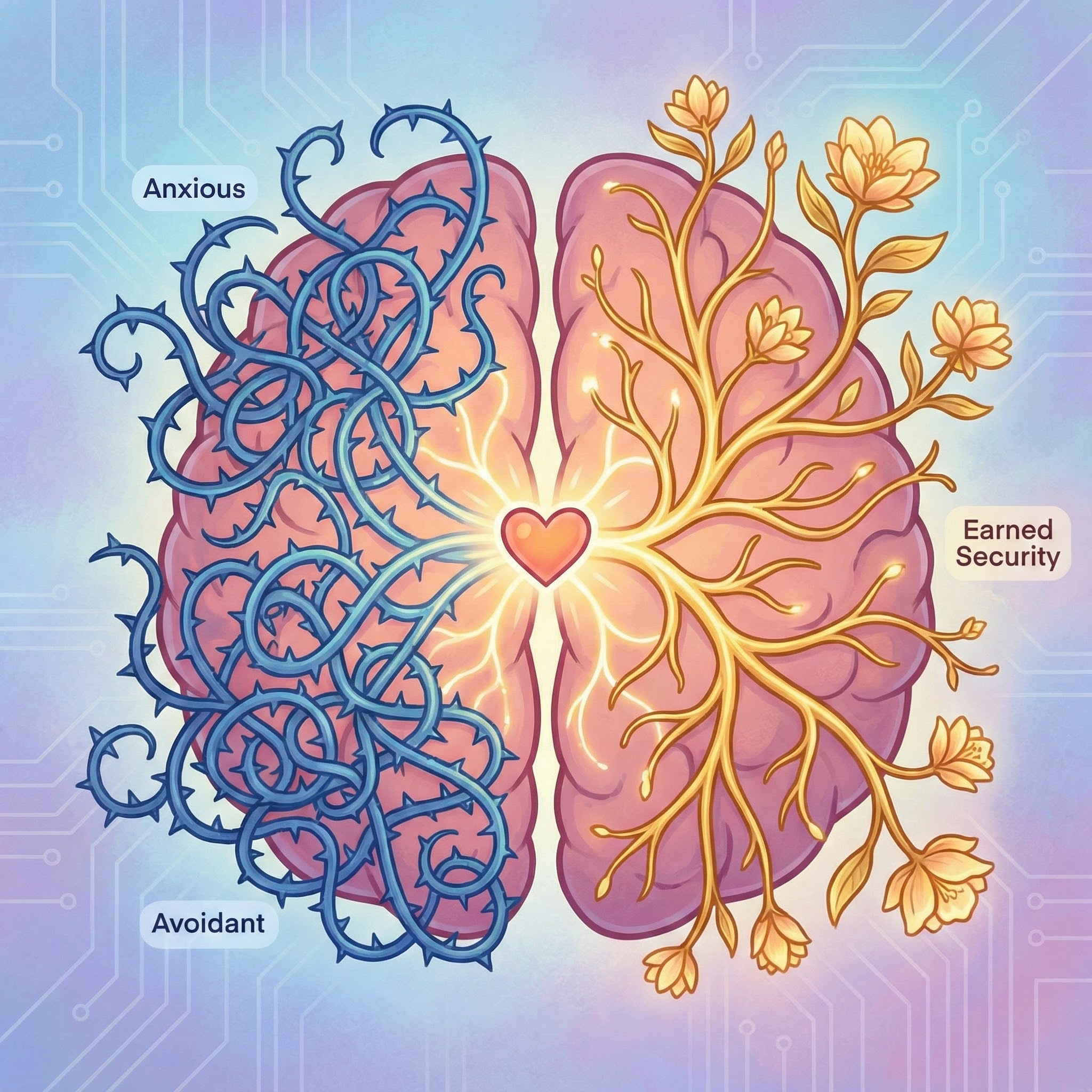
The good news? The brain is “neuroplastic.” This means it can change. Through a process called “Earned Secure Attachment,” you can literally rewire these neural pathways.
5 Evidence-Based Interventions to Heal Your Attachment
You don’t have to wait for a crisis to start healing. Here are five research-backed tools you can use today.
1. The “Pause” Protocol (Somatic Regulation)
- What it is: A physical intervention to stop the “fight or flight” spiral.
- Why it works: When your attachment system is triggered, your prefrontal cortex (thinking brain) goes offline. You cannot think your way out of a panic; you must feel your way out.
- How to do it:
- Recognize the trigger (e.g., “My chest is tight because he hasn’t called”).
- STOP. Do not text. Do not call. Do not withdraw.
- Practice 4-7-8 Breathing: Inhale for 4 seconds, hold for 7, exhale slowly for 8. Repeat for 2 minutes.
- When to use it: Immediately when you feel the urge to “protest” (anxious) or “run” (avoidant).
2. The “If-Then” Planning Strategy
- What it is: A cognitive behavioral tool to plan for triggers before they happen.
- Why it works: It reduces cognitive load during stress. Research shows that pre-deciding your actions helps you bypass old, automatic habits.
- How to do it: Write down a specific trigger and a new, healthy response.
- Example: “If I don’t hear from my partner by 6 PM, THEN I will go for a 10-minute walk instead of texting them three times.”
- When to use it: During a calm moment to prepare for future stressors.
3. “Name it to Tame it”
- What it is: A mindfulness technique championed by Dr. Dan Siegel.
- Why it works: Labeling an emotion moves activity from the emotional amygdala to the rational prefrontal cortex, literally calming the brain.
- How to do it: Instead of saying “I am anxious” (which defines your whole self), say “I am noticing a feeling of anxiety right now.”
- When to use it: When you feel overwhelmed by a wave of emotion.
4. The Self-Compassion Break
- What it is: A quick intervention from Dr. Kristin Neff’s research.
- Why it works: Attachment wounds are often fueled by shame. Self-compassion releases oxytocin, the “bonding hormone,” which antidotes the stress response.
- How to do it: Place a hand on your heart and say three phrases:
- “This is a moment of suffering.” (Mindfulness)
- “Suffering is a part of life; I am not alone.” (Common Humanity)
- “May I be kind to myself in this moment.” (Self-Kindness)
- When to use it: When you catch yourself spiraling into self-criticism.
5. The “Secure Base” Visualization
- What it is: An imagery exercise to simulate secure attachment.
- Why it works: The brain struggles to distinguish between vivid imagination and reality. Visualizing safety helps build the neural “muscle memory” of security.
- How to do it: Close your eyes and imagine a figure (real, imaginary, or even a pet) who accepts you completely. Imagine them sitting next to you, looking at you with warmth. Feel that safety in your body.
- When to use it: Before a difficult conversation or when feeling lonely.
When to Seek Professional Help
While these tools are powerful, attachment wounds are often deep and formed in the context of relationships—so they often need a relationship to heal. It may be time to seek therapy if:
- Your relationship patterns are affecting your ability to work or parent.
- You find yourself consistently attracting partners who mistreat you.
- You feel unable to control intense swings of anxiety or numbness.
Asking for help isn’t a weakness; it’s the first step toward the “earned security” you deserve.
Trusted Resources
- Hal Shorey, PhD – The Science of Attachment – Accessible articles on navigating attachment in modern dating.
- NIMH – Psychotherapies – Information on evidence-based therapies like CBT and DBT that support attachment work.
- The Attachment Project – Offers quizzes and educational resources to help identify your style.
Conclusion
Your attachment style is a part of your story, but it is not the end of the story. Whether you are anxious, avoidant, or somewhere in between, you have the capacity to grow toward security. It takes time, patience, and often a little help, but the peace of mind—and the quality of love—waiting for you is worth the work.
How We Can Help
If you’re in Southern Oregon and looking for support with relationship patterns or attachment issues, I’d be honored to help. At Helping Hand Therapy, we provide compassionate, evidence-based care in Ashland and Medford, as well as online throughout Oregon. Schedule a free 30-minute consultation at helpinghandtherapy.net to see if we’re a good fit.
For more tools, community events, and resources, visit our website at helpinghandtherapy.net under our resources tab.
REFERENCES (APA Format)
Bowlby, J. (1969). Attachment and loss: Vol. 1. Attachment. Basic Books.
Chopik, W. J., Edelstein, R. S., & Grimm, K. J. (2019). Longitudinal changes in attachment orientation over the lifespan. Journal of Personality, 87(4), 895–911.
Hazan, C., & Shaver, P. (1987). Romantic love conceptualized as an attachment process. Journal of Personality and Social Psychology, 52(3), 511–524.
Levine, A., & Heller, R. (2010). Attached: The new science of adult attachment and how it can help you find—and keep—love. Penguin.
Siegel, D. J. (2020). The developing mind: How relationships and the brain interact to shape who we are (3rd ed.). Guilford Publications.
Vrtička, P., Andersson, F., Grandjean, D., Sander, D., & Vuilleumier, P. (2008). Individual attachment style modulates human amygdala and striatum activation during social appraisal. PLOS ONE, 3(8), e2868.